


 Download area


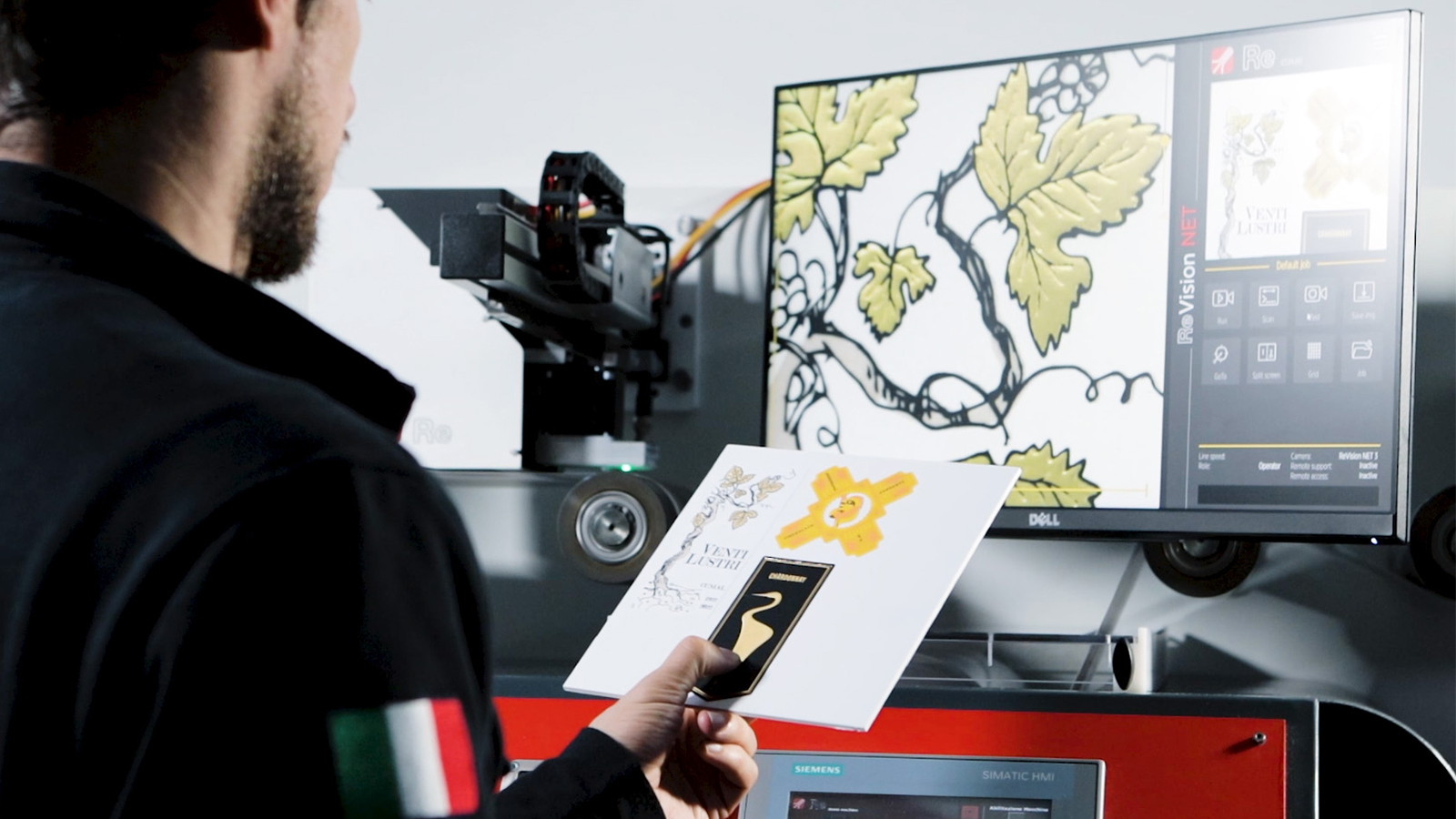
A web viewing system is now an essential tool for monitoring print quality in real time on a moving web. Through cameras, lighting and visualization software, it allows the operator to control the process, identify printing defects more quickly to reduce waste.
What you will find in this article:
In modern printing lines, substrates run at very high speed and with increasingly tighter error margins. In this context, relying only on the operator’s direct visual inspection is no longer enough. Even small defects, if detected too late, can cause large amounts of wasted material, machine stops, reprints and delayed deliveries. For this reasons, a web viewing and print monitoring system has become an increasingly important tool for improving process control and protecting final print quality.
> What is a print control system?
A web viewing system, also called print monitoring system, is a technology that uses high-speed and technological cameras to continuously acquire images of a printed web in motion.
This system allows the operator to view any print defects or anomalies on a monitor in real time and to react quickly to process issues. The main advantage is clear: detecting an error earlier means preventing it from affecting hundreds or thousands of meters of material, with the resulting increase in waste and loss of efficiency.
A web viewing system does not necessarily replace the operator’s control, but it makes it far more effective. Instead of observing the material directly on the press, often at speeds that are too high for reliable inspection, the operator can monitor enlarged, stable and continuous images of the print, gaining a much clearer view of the process.
> Why is web viewing important for print quality?
In today’s printing industry, which is characterized by very high competition, the margin for error is extremely small. Efficiency and quality are no longer separate goals. They must go hand in hand.
Modern printing presses can run at speeds of more than 1000 m/min, making traditional manual inspection increasingly impractical. At the same time, print jobs are becoming more sophisticated, and some defects may be very small, intermittent or difficult to detect with the eye.
This is why real-time print monitoring is so important. Even a seemingly minor defect, if not detected for just a few minutes, can result in significant material waste, reprints, production stops and delivery delays.
A web viewing system therefore helps prevent problems such as:
- color variations, misalignment and ink smearings
- register issues
- repetitive print defects
- excessive material waste
To sum up, the faster an anomaly is detected, the greater the chance of reacting in time and reduce its impact on both the process and the final product.
> How can print quality be controlled?
There are several ways to control print quality. They can be summarized in order of increasing cost and effectiveness.
Traditional manual inspection
This is the simplest method. The operator periodically stops the machine, takes or observes a section of printed material, checks its quality and then restarts the process. The advantage is that it does not require specific investment, but its limits are obvious: it causes machine stops, does not provide continuous monitoring and increases the risk of detecting a problem too late, with the result of high waste levels.
Manual inspection with a strobe light
In this case, the machine keeps running while the operator observes the printed substrate using an external strobe light. Compared with traditional manual inspection, this approach reduces machine stops, but it still depends heavily on the operator’s attention, experience and reaction speed. In addition, not all defects can be easily detected in this way.
Web viewing or print monitoring system
This is a technological system that acquires images of the printed web through high-speed cameras and displays them on a monitor in real time, often with magnification useful for analysis. Compared with more advanced systems, it is a relatively cost-effective solution, yet it is already highly effective in improving process control. The operator still plays an active role in identifying defects, but does so with tools that make inspection much faster, more accurate and continuous.
Automatic print inspection system
This is the most advanced solution. In addition to image acquisition, it includes software capable of automatically detecting defects and, depending on the system configuration, supporting faster and more structured process intervention. These systems are more complex and more expensive, and are typically designed for applications where the required level of automation and quality control is particularly high.
> How does a web viewing system work?
A web viewing system is an advanced technology that combines image acquisition, data processing and real-time visualization to enable effective print control.
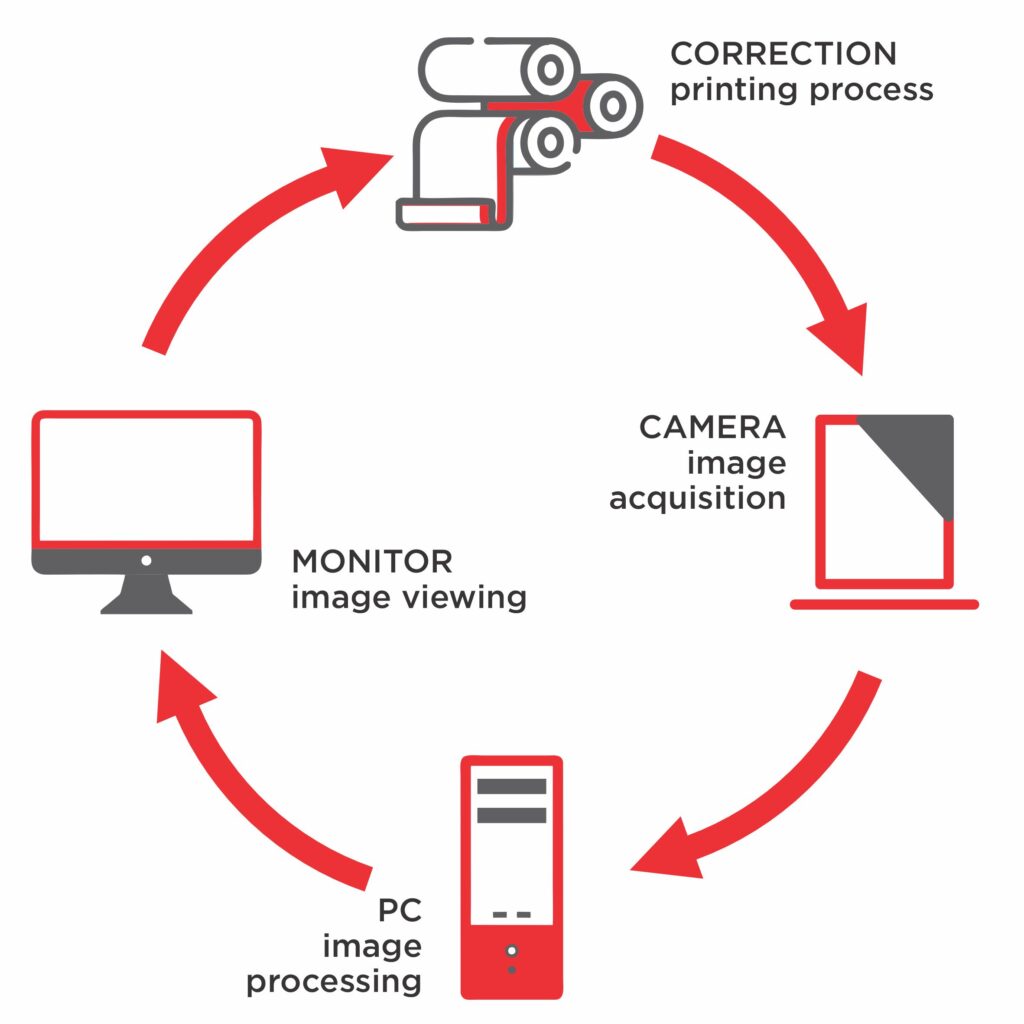
Its operating principle can be summarized as follows:
image acquisition → data processing → image display → print correction
More specifically, the print monitoring process works in this way:
- A camera acquires images of the printed substrate in motion, even at high speed, and sends them to a computer.
- The computer processes the incoming data and generates the image to be displayed.
- The image is shown on the monitor in real time, in a stable and readable way for the operator.
- The operator observes the image to identify possible defects, comparing it with the correct print reference.
- Once a problem has been detected, the operator can quickly adjust the printing process, limiting waste and restoring optimal production conditions.
This is where the value of the system lies: reducing the time between the appearance of a defect and its detection, allowing a much faster response than traditional inspection methods.
> Main components of a web viewing system
In a print viewing and monitoring system, several components must work in perfect synchronization in order to deliver reliable and effective results.
Camera
This is the element that captures images of the printed substrate while it moves at high speed. It is equipped with sensors and optics designed to ensure clear and accurate image acquisition. Depending on the application and the width of the material to be inspected, the system may offer a wider or narrower field of view. Another important variable is movement along a scanning rail, which can be either manual or automatic.
Lighting
Lighting is a critical element because image quality also depends on the ability to illuminate the material correctly. Lighting can be integrated into the camera, as in Re devices, or provided externally, depending on the system configuration.
Computer
This is the brain of the system. It receives the images captured by the camera, processes a very large amount of data and returns a faithful and readable image to the monitor for evaluation by the operator.
Monitor
This is the operator’s visual interface. The images captured by the camera are displayed here in real time, allowing zooming, checking and verification operations that help identify print defects more easily.
Synchronization systems
These are essential for obtaining a stable image on the monitor. A web viewing system must be properly synchronized with both line speed and print repeat. This synchronization can be achieved through proximity sensors, encoders, contrast sensors or PLC integration.
> Applications and advantages
Today there are many applications in which a print viewing and monitoring system has become practically indispensable.
In the label printing industry, flexible packaging, commercial printing, as well as in security printing such as banknotes and checks, and in pharmaceutical printing, a web viewing system is an important support for quality control.
The same is true across different printing technologies, including flexographic printing, offset printing, digital printing and rotogravure printing.
In these contexts, a web viewing system makes it possible to:
- monitor print quality in real time
- identify print problems more quickly
- reduce reaction times
- minimize waste by adjusting the process before defects turn into large-scale losses
- reduce dependence on direct manual inspection
- improve process stability
- increase line speed, because the operator works with greater confidence and control
- reduce machine downtime
All of these benefits result in better final product quality and higher overall production efficiency.
> Re solutions for print viewing and monitoring
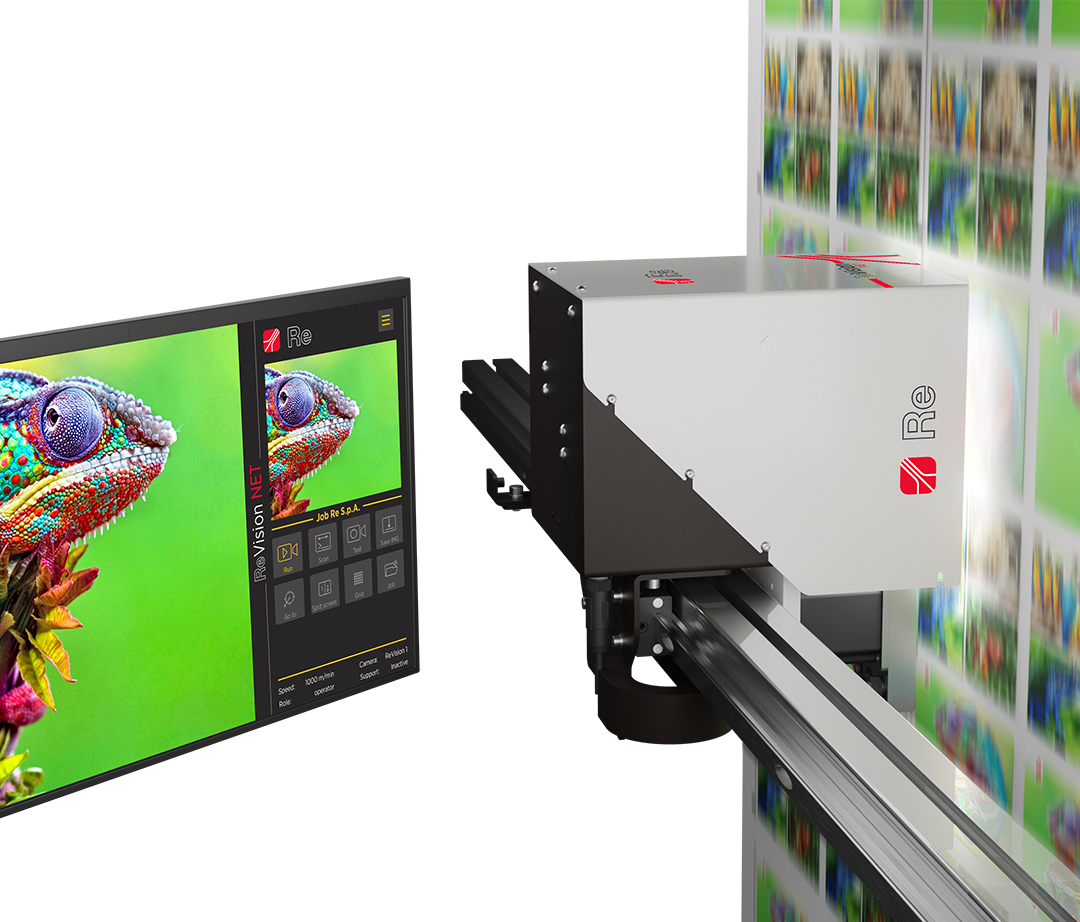
Re S.p.A. has developed a highly advanced and innovative web vision system called ReVision NET.
Thanks to a special latest-generation optical system, it can detect details down to 10 microns and operate at speeds of up to 1200 m/min, displaying high-resolution images on the monitor with bright, accurate colors even in particularly demanding applications such as gold leaf, fluorescent colors and embossed print.
It is available with four fields of view, depending on the application:
35 × 29 mm, 130 × 109 mm, 200 × 168 mm, 350 × 296 mm.
The system is equipped with a 24” touch screen monitor, featuring a user-friendly interface and a wide range of functions designed to ensure practical, fast and effective print control.
F.A.Q.
A web viewing system is used to monitor print quality in real time on a moving substrate. It helps the operator identify defects, anomalies and process variations more quickly than with traditional manual inspection.
It works by capturing images of the printed material through a high-speed camera, processing them through a computer and displaying them in real time on a monitor. This allows the operator to monitor the process and intervene quickly when defects appear.
The main components are the camera, lighting, computer, monitor and synchronization systems. Together, they allow the print image to be captured, processed and displayed in a stable and accurate way.
Web viewing provides continuous monitoring of the print and supports the operator in identifying defects. Print inspection adds a more advanced level of automation, using software capable of automatically recognizing anomalies and managing them in a more structured way.
It shortens the time needed to detect a print problem. This makes it possible to intervene before the defect is repeated over large quantities of material, reducing waste, machine stops and reprints.